


Winter Quarter 2026
- For day, time, room, and TA information, see our PDF schedule or Schedule Builder
- For all courses not described here, see:
Catalog Descriptions
Course Descriptions & Flyers
- RST 001G — Myth, Ritual, & Symbolism
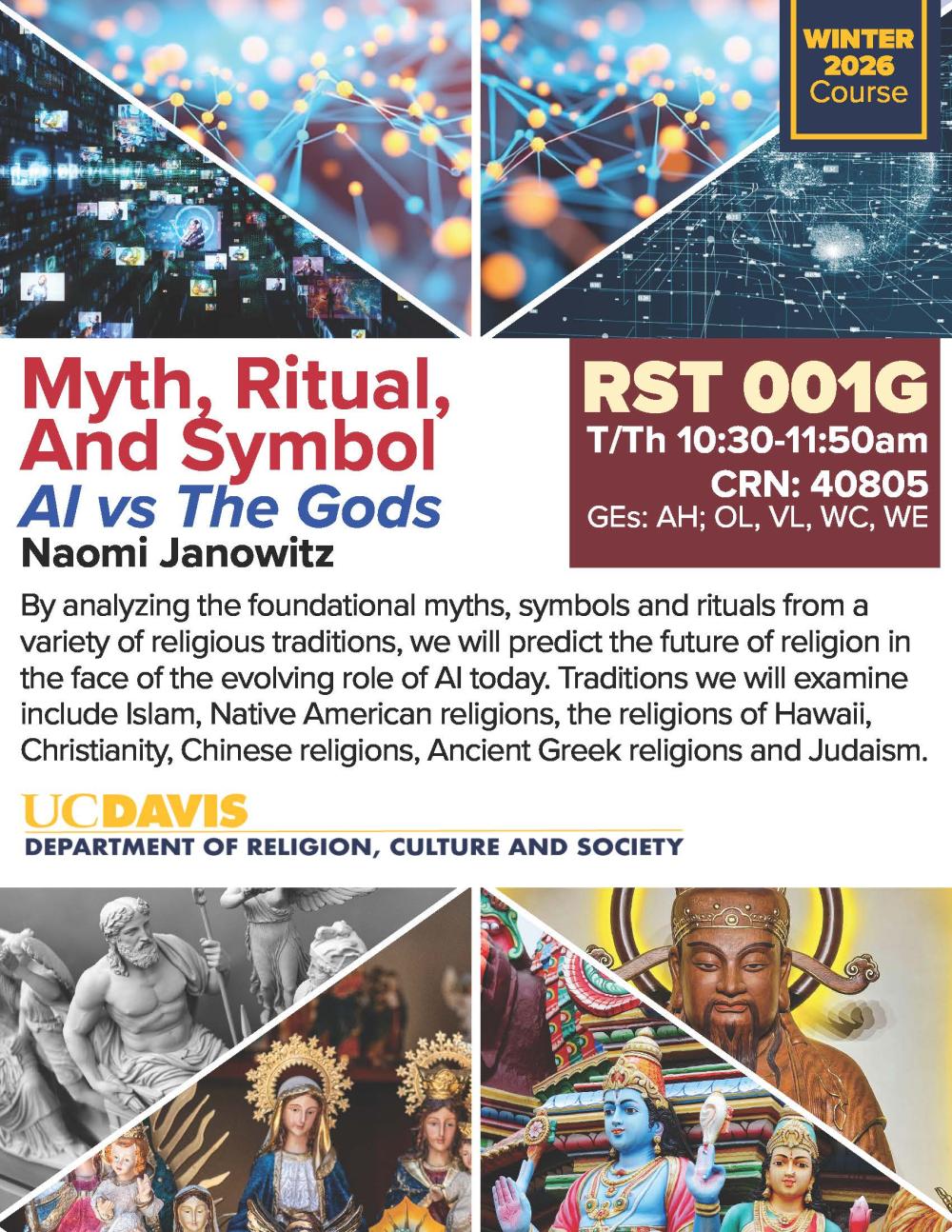
Naomi Janowitz By analyzing the foundational myths, symbols and rituals from a variety of religious traditions, we will predict the future of religion in the face of the evolving role of AI today. Traditions we will examine include Islam, Native American religions, the religions of Hawaii, Christianity, Chinese religions, Ancient Greek religions and Judaism.
GE: Arts & Humanities (AH); Oral Skills (OL); Visual Literacy (VL); World Cultures (WC); Writing Experience (WE).
- RST 008 — Healthcare & Religious Ethics
Wendy Terry - Ethical dilemmas in healthcare and religion. End of life, illness, responsibility for the common good, humanity’s relationship to the natural world, growing up, birth, pregnancy, conception. GE: Arts & Humanities (AH); American Cultures, Governance, & History (ACGH); Domestic Diversity (DD); World Cultures (WC); Writing Experience (WE).
- RST 011 — Ethical Eating
Lynna Dhanani In every culture food lies at the center of a complex value system that involves religious beliefs and rituals, social hierarchies, and gender distinctions. Food is the cement that binds groups together, but it also separates individuals according to age, wealth, status, and gender. Both natural product and social construction, food should be “read” in specific cultural contexts. It is the purpose of this course to introduce students to the varied ethical, religious, and cultural meanings food has had across the centuries and globe as well as to its physical effects. This course also assesses our modern industrial forms of food production on the animals we raise and eat, on our environment, and its effects on our own bodies. Included as part of our journey through food cultures and production are guest lectures and a possible field trip to the UC Davis Student Farm and/or a local organic farm.
GE: Arts & Humanities (AH); Oral Skills (OL); Visual Literacy (VL); World Cultures (WC); Writing Experience (WE).

- RST 045 — Christianity
Wendy Terry - Major concepts and practices in the Christian tradition. Survey of the history of Christianity and Christian expansion from antiquity to modern times. Pays particular attention to Christianity in China, India, Africa, the Middle East, and Latin America. GE: Arts & Humanities (AH); Visual Literacy (VL); World Cultures (WC); Writing Experience (WE).
- RST 060 — Introduction to Islam
Mairaj Syed This course offers an introduction to Islam across its historical sweep, from its origins to its contemporary expressions. Beginning with the Prophet Muhammad's transformative message in seventh-century Arabia, we trace the development of Islam's central beliefs, institutions, and practices through time. We explore the rich intellectual traditions that flourished in medieval Muslim societies—Islamic law, theology, and mysticism. We then examine how colonialism and Western modernity influenced Islamic thought, practice, and culture. The course concludes by engaging with themes that animate Islam in contemporary America, connecting past and present in the lived experience of Muslim communities today.
GE: Arts & Humanities (AH) or Social Sciences (SS); World Cultures (WC); Writing Experience (WE).

- RST 065C — The Qur'an & Its Interpretation
Ryan Brizendine - The Qur'an, its history, its various functions in the lives of Muslims, and its different interpretations. Quranic themes such as God and humankind, nature and revelation, eschatology and Satan. Islam and other religions; women, gender, and sexuality. GE: Arts & Humanities (AH); World Cultures (WC); Writing Experience (WE).
- RST 123 — Sex & Gender in the Bible
Naomi Janowitz - Gender and sexuality in the Bible and its interpretation in Judaism and Christianity. Femininity and masculinity; gender roles; homosexuality; sexual violence. Historical origins in the ancient world; influence on contemporary views. GE: Arts & Humanities (AH); World Cultures (WC); Writing Experience (WE).
- RST 137 — Topics in Buddhism
Layne Little - Thematic exploration of historic developments, periods, regions and sects in Buddhism from an interdisciplinary perspective. GE: Arts & Humanities (AH); World Cultures (WC); Writing Experience (WE).
- RST 154 — The Hindu Temple
Layne Little - Comparative history of architecture and symbolism of the Hindu Temple in India, Southeast Asia and the United States. Attention to the temple as expression of religious knowledge, political authority, and cultural heritage through the lens of colonialism and postcolonialism. GE: Arts & Humanities (AH) or Social Sciences (SS); Visual Literacy (VL); World Cultures (WC); Writing Experience (WE).
- RST 155B — Bhakti: Indian Devotional Traditions, 1200 CE to Present
Ryan Brizendine - Indian devotional traditions through literary, visual, and performance culture. Emphasis on period 1200 CE to the present. GE: Arts & Humanities (AH); World Cultures (WC); Writing Experience (WE).
- RST 159 — The Mahabharata
Lynna Dhanani This course investigates the history, diversity, and influence of the Mahābhārata tradition. It studies the Sanskrit epic itself as well as retellings from different religious and performative contexts. Ten times the length of the Odyssey and Iliad combined, the Mahabharata is massive not only in size but in cultural importance. Unlike Homer’s epics, it remains vibrantly alive today, as it has been for more than 2,000 years. Its gods are worshiped, its episodes are continually reinterpreted, and its stories have a fresh life in the imagination of most Indians. Endless literary and performative forms have emerged in every region, social class and genre in the Indian subcontinent. International artists have given it new theatrical and musical life. The Mahabharata is packed with stories of passion, politics, war, love, loyalty, hatred. Its episodes, which include the Bhagavad Gita, also explore ethics and ultimate meaning.
GE: Arts & Humanities (AH); World Cultures (WC); Writing Experience (WE).
